Over the past year, UNFPA and The Lancet released findings that offer a clear view of the maternal health interventions that save lives. This evidence affirms the efficacy of the most widely-used systems- and treatment-level interventions in the field. It clearly demonstrates good quality, comprehensive reproductive health services, including access to emergency obstetric care, family planning and antiretroviral (ARV) therapy, is key to reducing maternal mortality. And this complement of care must be delivered in strong, fully functional health systems.
Global reductions in maternal deaths are finally appearing at the population level, for the first time during my career. This holiday season, unlike any before, we can reflect on these accomplishments with renewed pride based on hard evidence, proof that our work is creating real global change.
However, the vast gains made in some countries, while great cause for optimism, must not be allowed to mask the much slower progress—even reversals—in others, most especially those experiencing conflict and crisis. Fragile states do not have the functional health systems and the necessary trained clinicians, medicines and equipment to reduce maternal death.
Now that we have the evidence to confirm that our interventions save lives, we must continue to apply this knowledge to those most in need. Women still become pregnant and experience life-threatening complications during war and in the aftermath of floods and earthquakes. They want to prevent pregnancy in these circumstances; they still want to space or limit their births. The proven interventions to prevent maternal death must be implemented or strengthened in countries experiencing or emerging from humanitarian emergencies.
Knowing what works isn’t enough. We’ll need the collective will and financial commitment to provide reproductive health care in crisis-affected countries that, to date, have been sorely lacking.
Women have a fundamental right to good quality care and a health system that can consistently provide it, no matter the crisis going on around them. When these are prioritized, we can expect an even more dramatic decline in women’s needless suffering and death.
Therese McGinn, DrPH, Director, The Reproductive Health Access, Information, and Services in Emergencies (RAISE) Initiative. The RAISE Initiative works to catalyze change in how reproductive health is addressed by all sectors involved in emergency response, from field services to advocacy, from local aid providers to global relief movements.
Perspectives of Faculty and Students from Columbia University's Mailman School of Public Health
Monday, February 14, 2011
Tuesday, January 4, 2011
It Takes a Community to Treat an Epidemic

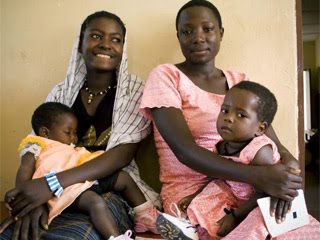
Women and their children wait to receive maternal child health services at a health center in Tanzania. Photography by Nathan Golon.
It was late in the afternoon when we finally arrived at the health center. A jubilant clinical officer came out to meet us followed by two dozen peer educators, all singing and dancing in a heartfelt welcome. I was proudly informed that this small health center had already engaged close to 300 persons with HIV in care and had close to 200 already started on HIV medicines. These are just a few of the millions who have benefited from the HIV scale-up, a historic public health achievement. While only about 100,000 individuals with HIV in low and middle income countries were able to access treatment in 2002, by the end of 2009 this number has skyrocketed to close to 4 million. Most remarkably, sub Saharan Africa is the region that has had the most dramatic increase.
How was this achieved in a region plagued with weak health systems and a multitude of health crises? Shortage of skilled health care workers, lack of continuity model of healthcare for a chronic condition like HIV, dilapidated facilities, inadequate laboratories, entrenched stigma, and poverty are just some of the challenges that faced the HIV response. As I walked around the health center, I kept pondering the question, “how was this accomplished and what does it teach us?” I visited the cramped room where the clinical officer saw all her patients, where the 44 charts of the ones she had seen that day lay on the rickety table. I opened one chart and saw the neatly filled rows of information. I followed her to the pharmacy, a tiny room where the precious medications are kept under lock and key, then passed by the laboratory where a technician proudly showed me his new equipment and his impeccably organized registers.
The answer to my question dawned on me when I finally sat down to talk with the staff and the peer educators, themselves living with HIV. The answer lay in the fact that they were one, one team that worked together hand in hand. No hierarchy was evident, no sense of the provider as the source of wisdom and the patient as the passive recipient. The staff described the needs of the community, the gaps in services and the innovations they had come up with to cope with impediments. The peer educators astutely asked about nutrition and poverty. They shared their need for new bicycles to be able to make home visits to check on the patients assigned to them. All were passionate about their community, all were adamant on achieving high quality of care, all were cognizant of their individual value as well as their collective power.
Many years into the future, when the history of the HIV response is written, some will credit the billions of dollars of resources for the achievements. Yet, a most important factor might be overlooked. The secret of this remarkable success may lie in the partnership that I witnessed between passionate and committed staff members with knowledgeable and empowered patients.
Wafaa El-Sadr, MD, MPH, is director of ICAP at Columbia University and director of the Center for Infectious Disease Epidemiologic Research (CIDER) at Columbia University’s Mailman School of Public Health. Dr. El-Sadr also is professor of clinical medicine and epidemiology at Columbia University.
Thursday, December 9, 2010
Jeffersonian Insights on Public Health

I recently gave a presentation to medical students and faculty at the University of Virginia organized by their Center for Global Health. UVA has a strong tradition in tropical infectious disease work in developing countries, with groundbreaking research addressing diseases such as leishmaniasis. However, like many other institutions, UVA has recently seen a broad swell of interest on a range of global health issues amongst its student population and I had been asked to address the medical school on thinking at Columbia about emerging challenges in the field.
I had anticipated that my slides arguing that chronic, rather than infectious disease stands to be the focus of greatest preventable mortality in the coming years to be the most controversial. But it was one of my slides in the section talking about globalization and the broader political and economic changes that are shaping the landscape of global health that drew the strongest reaction. Squeezed between slides depicting Chinese investment in health infrastructure in sub-Saharan Africa and material outlining development in communications technology was – for me – a ‘commonplace’ graphic. It depicted the decline in the health workforce across Africa since the year 2000, with international migration to the developed world one of the major factors contributing to a declining available capacity to address escalating needs.
Touched on briefly during Q&A, a moving email on the topic hit my inbox shortly after the lecture. It asked for a copy of this slide so that the writer – a medical student with experience of working in Uganda – could share this evidence with friends and family of the ‘north’ drawing resources from a ‘south’ that could so ill-afford such hemorrhage. I was touched by her commitment to advocacy and, if truth be told, a little envious of the clarity with which she saw a moral issue on which I have become somewhat jaded by complexity and pragmatism.
Coincidence makes bad science. But it can valuably fertilize the imagination. The following day I was touring the Monticello estate on the outskirts of Charlottesville, which has been restored to the condition in which Thomas Jefferson spent his retirement years. The house and gardens were wonderful, but it was the ‘Plantation Community Tour’ – visiting the remains of the homes and workshops of the slaves on whose labor the estate depended until the time of Jefferson’s death – that was most compelling. We had noted in the house how Jefferson had seen slavery as an "abominable crime" and a "moral depravity”. But he continued to hold slaves to the end of his life, with the crucial economic role they played in the operation of his estate and his deep indebtedness (which saw slaves sold on his death to pay creditors), clearly a major barrier to translating his moral conviction to economic practice.
There was much complexity and pragmatism operating in Jefferson’s 18th century calculus on the issue of slavery. 250 years later we recognize his moral impulse to be profoundly correct and his economic compromise to be profoundly indefensible. The voluntary movement of doctors and nurses from Africa to the developed world is a radically different phenomenon from the forced movement of Africans centuries before. But there are enough parallels in the hegemony of a political and economic order to cause one to wonder at the casual acceptance of gross inequality in the human experience. When visitors to a futuristic museum of global health in the 21st century learn that movement of doctors from settings where there is one physician for 50,000 people to settings where there is one for every 500 was seen as an inevitable consequence of our global economic system, how will they judge us? I fear my own rationalizations on the issue sound rather too like Jefferson’s on slavery. My hope lies in the passion of that medical student and thousands like her that see global health not as a career specialization but as a moral quest.
Alastair Ager is Professor of Clinical Population and Family Health at the Mailman School of Public Health, working with the Program on Forced Migration & Health. He serves of Executive Director of the Global Health Initiative.
Wednesday, November 24, 2010
The "Green" Agenda in Contemporary Brazil: Fact or Fiction?
The October 2010 elections in Brazil revealed the unexpected popularity of Marina Silva, a presidential candidate supported by the small Green Party. Due to the huge size of the country, its deep heterogeneity, the comprehensiveness of the process and the absence of any mandatory linkage between regional and national representatives, the 20 million votes received by Marina Silva as a president candidate did not translate to the Green Party’s overall performance. The Green Party was and is a small party, with a modest number of representatives in the Congress (15/513), without a single senator (0/81) or governor (0/27) elected in this round.Brazilian campaigns are relatively small and cheap compared to their North American counterparts; partially due to the fact political parties have free time on both television and radio. Nevertheless, the scope and the costs of Brazilian campaigns have been increasing, due to an increasing population (~185 million people) living in a network of over 5,500 municipalities, as well as its increasing professionalization (e.g. involving political advisors, parties’ sponsored polls etc.). Big politics is translated, in Brazil as anywhere else, into rising costs and the need to use nationwide party structures. Half of the expenses of Marina Silva’s campaign were paid by the then vice-president candidate, Guilherme Leal, founder and chairman of Natura, the world’s largest company in the field of organic cosmetics.
Marina Silva’s 20 million votes should be viewed as resulting more from a combination of her personal leadership and the growing power of Brazilian companies committed to sustainable development than to a “green boom”. In the context of a harsh competition between the two major political coalitions (supporting the elected president Dilma Rousseff and her main adversary, Jose Serra), Marina Silva also appeared to be viewed as a new, “third” way.
In the second round of the elections both major coalitions stated they would incorporate the “green agenda” into their own plans. Dilma Rousseff was elected by a large political coalition and it is too early to fully understand the broad agenda to be followed by her presidency. The stage is set for the reemergence of the long-term conflict between the so-called “ruralists” (i.e. large farmers and leaders of agribusiness in Brazil) and the MST, the movement of landless peasants, as well as the conflicts between environmentalists and the supporters of accelerated development at the expenses of environmental degradation. Such conflicts tend to be especially violent in Brazil and it is no coincidence that Marina Silva’s regional leadership (in the state of Acre, in the northwest border of Brazil’s Amazon Rain Forest) is usually viewed as a leadership consolidated after the brutal murder of Chico Mendes, her former mentor and the late leader of the Brazilian rubber taper union (http://en.wikipedia.org/wiki/Chico_Mendes).
Brazil ranks nowadays as one of the main forces of agribusiness and the main producer of biofuels (especially sugar cane ethanol), worldwide. The country houses both the largest extensions of pristine forests in the whole world, as well as retaining the unfortunate record of having the fastest pace deforestation rate.
With an expected annual growth of its GDP of 7.5-8% in 2010, Brazil is an emergent partner in the complex and contradictory world agenda on global warming, protection of the environment, and biodiversity.
The world’s environmental agenda remains a big puzzle to be debated in the next rounds of the global diplomacy on the environment and climate changes. There is no consensus either within the US or between the US and its main partners, China and India. Much likely Brazil will have a central role in the global negotiations, depending on its own capacity to establish domestic consensus. Marina Silva is a key term in this global equation.
Global health is closely intertwined with environmental conditions in a broad sense and this interrelationship will undoubtedly become even more entangled in the coming years, with the increase of population, global warming, and scarcity of vital resources such as clean water and non-renewable energy. As a professional working in the field of global health, I see means of sustaining the ‘green agenda’ in Brazil, as globally, both increasingly politically complex and increasingly politically crucial.
Francisco I. Bastos, is a researcher at Fundação Oswaldo Cruz (FIOCRUZ) Rio de Janeiro, Brazil, working with Mailman School faculty to establish a GHI ‘Global Partners Alliance.’ As with all ‘Global Posts’ the views expressed are personal and do not reflect the institutional positions of either FIOCRUZ or Columbia University.
Subscribe to:
Posts (Atom)